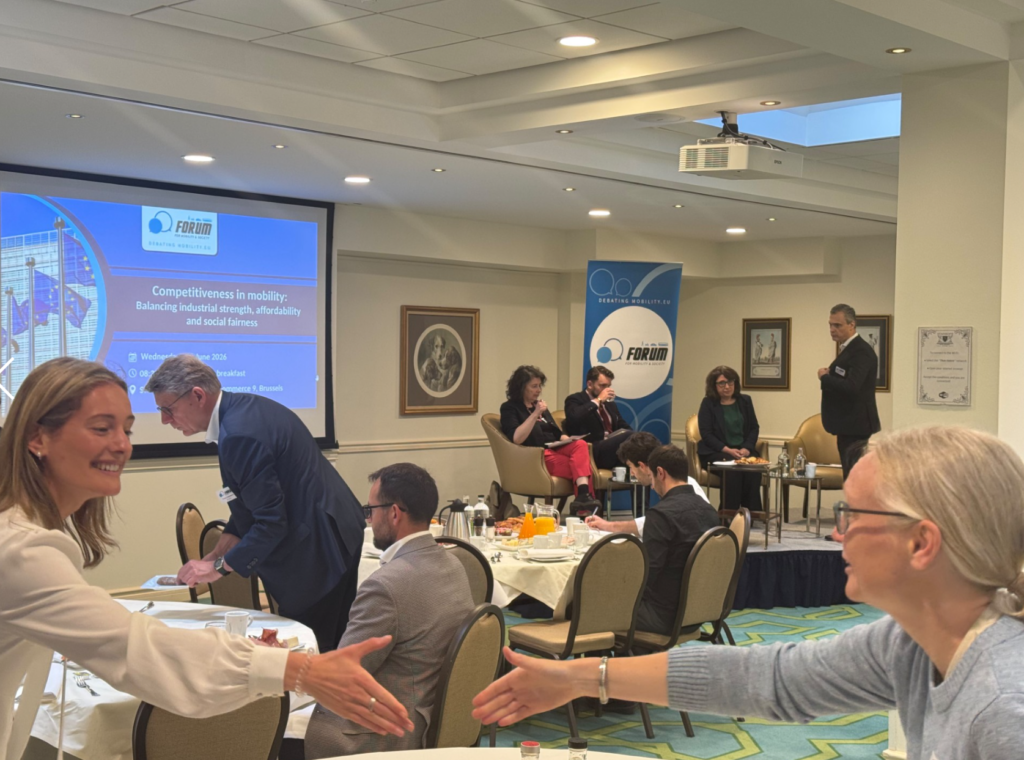
Brussels, 10 June 2026 – The Forum for Mobility and Society (FMS) convened yesterday in Brussels to discuss how Europe can strengthen its industrial competitiveness while ensuring mobility remains affordable and socially fair.
Hosted at the Stanhope Hotel, the event brought together leading experts from the European Parliament, the tyre industry, and the passenger transport, aftermarket, and insurance sectors among others, to discuss the challenges facing Europe’s mobility ecosystem as it navigates the green and digital transitions.
Moderated by Diogo Pinto, Director General at FIA Region I, the discussion focused on the growing need to balance industrial resilience, sustainability objectives and the affordability of mobility.
Jacob Stendevad, Renew Policy Adviser responsible for the IMCO Committee, highlighted the complex policy choices facing European decision makers as they seek to reconcile climate objectives, affordability concerns and the need to strengthen Europe’s industrial competitiveness. He emphasised the importance of identifying practical solutions that support the transition while safeguarding jobs and economic prosperity.
Marta Conti, Director of Public Affairs at Tyres Europe, stressed that competitiveness must be understood as an ecosystem challenge. She underlined the importance of supporting European manufacturing, encouraging innovation and helping consumers make informed choices that improve safety, efficiency and sustainability. The discussion highlighted the role that tyres and other vehicle components can play in reducing emissions and improving vehicle performance throughout their lifecycle.
Suzanne Hoadley, Senior Adviser on Passenger Transport at IRU, brought the perspective of passenger transport operators, many of which are small and medium-sized enterprises facing rising operational costs. She highlighted the importance of ensuring that the transition to zero-emission mobility remains economically viable, noting the need for financial support, charging infrastructure and access to the electricity grid.
The Forum agreed that affordability must remain a central consideration throughout the transition and that public policies should help citizens and businesses adapt to changing market conditions.
Participants also discussed the implementation of ETS2 and the Social Climate Fund, stressing the need to direct carbon pricing revenues towards supporting households, consumers and transport operators, while calling for greater cooperation across the mobility ecosystem and continued dialogue between policymakers, industry and citizens.
As Europe charts the next phase of its mobility transition, the challenge will be to turn competitiveness, affordability and social fairness into mutually reinforcing objectives rather than competing priorities.